Modifications to the laws are made each year by IFAB. Click the below link to download and familiarize yourself with modifications to the Laws of the Game by League.
The Wisconsin Soccer Leagues have asked us to help clarify and educate referees on what types of language are allowed and how referees can address & handle it.
Guidelines from International Football Association Board (IFAB & FIFA)
https://www.footballrules.com/offences-sanctions/arguing
What is arguing in football/soccer?
Arguing, complaining or protesting about a decision is known as ‘dissent’ in football. It can be verbal (with words) or physical (running at the referee, making gestures, kicking or throwing the ball away, etc.).
How do referees deal with arguing in football/soccer?
Players, substitutes, coaches and other team officials should respect the decisions of the referee and the other match officials.
An initial, instinctive, non-exaggerated manifestation of disagreement, objection or complaint is usually accepted by the referee as a natural reaction.
However, clear and/or continual dissent (with words, actions or gestures) is punished with a yellow card and, if play is stopped because of the dissent, an indirect free kick is awarded to the other team.
If the words or gestures are offensive, insulting or abusive, the player must be shown a red card.
https://www.footballrules.com/offences-sanctions/insults-and-abuse
What is insulting and abusive behavior in football/soccer?
Any language and/or actions that are offensive, discriminatory, insulting or abusive must be dealt with strongly by the referee.
How is insulting and abusive behavior penalized in football/soccer?
A player must be shown a red card if they:
-use offensive, insulting or abusive language
-make an obscene gesture
-behave or act in a violent or offensive way
This applies for offences committed against any person in a match, including outside agents like spectators or parents.
The referee must judge whether bad language (swearing) is offensive, discriminatory, insulting or abusive. If it is not, then the offender may be shown a yellow card or given a warning.
Further Instruction
Profanity, also known as ‘swearing’, ‘cursing’, or ‘cussing’, is the usage of notionally offensive words for a variety of purposes, including to demonstrate disrespect or negativity, to relieve pain, to express a strong emotion, as a grammatical intensifier or emphasis, or to express informality or conversational intimacy.
Lets break down how this can happen in a soccer match. We can equate it to that of the physical offenses listed in Law 12. Trifling offenses are those which technically violate a rule, but do not have any meaningful affect on the game and can be mostly ignored. Careless offenses are punished with a simple free kick as somewhat accidental or innocuous in nature. Reckless fouls are cautioned because they are committed without regard to the safety of the opponent. Serious foul play is punished with a send off because it deliberately endangers the safety of the opponent.
Language & words could also be thought of in a similar manner and could be be similarly trifling, careless, reckless or excessive
‘Trifling’ could be a quiet and brief outburst due to frustration at oneself or a teammate – only heard by a few and having almost no effect. ‘Careless’ could also be the use of words that are generally thought of as profane or vulgar – but in a way to give emphasis to a teammate of the importance or urgency of the message. They may also be used in an attempt at humor. These can be tolerated, though reminders that the tone and words need to be tempered and return to civil and respectful tones is needed. As officials, we can treat these with the same seriousness as we would a normal foul. While not acceptable, and needing to be addressed, there is usually no need for misconduct.
When we feel the language arises to ‘reckless’, it needs to be cautioned so all participants are aware that it won’t be tolerated. Once these words and phrases become loud and public, then a more stern response is expected. Temporary loss of temper or control could be handled in different ways by the referee – but when the words are used while arguing or challenging the referees authority, then a caution is needed for Dissent. Those same profane words that could be considered minor when directed at oneself or a teammate, take on a different tone when directed at others, or where other participants can be affected. Repeated and public uses of profanity should result in yellow card for Unsporting Behavior – especially if a warning is ignored. It is the duty of the referee and assistants to be aware of how the language affects others – and especially when it’s directed at the match officials themselves. Using a caution to warn the player to not engage in the behavior works the same as a caution for a reckless challenge.
Finally, when it rises to ‘excessive’ and fits into the category of Offensive, Insulting or Abusive, it needs to be handled as a much more serious offense. When the words are used as a personal attack, to belittle, intimidate, harrass or embarrass another participant, then we must send off that individual and report the misconduct. These actions may also be done without using profanity (gestures), but very often contain those words as well. The manner and context in which they are used can be important factors in your decision. These decisions must be documented and reported in the RefInsight incident report area so the league can take action to rid the game of this behavior.
This applies to players on the field as well as coaches in the technical area. Spectators and parents should also be removed from the match if profanity fits into any of these categories and affects players or referees on the field.
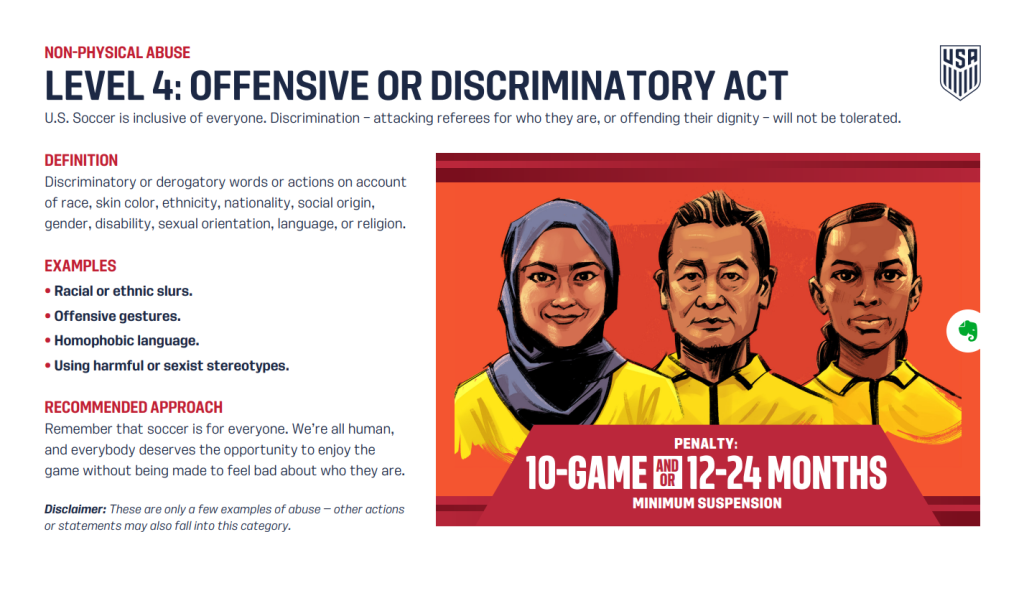
In addition, U.S. Soccer has outlined in it’s Referee Abuse Prevention policies – several examples as to what constitutes Abuse towards an official. These can be reported as as Referee Abuse category in the RefInsight incident report.
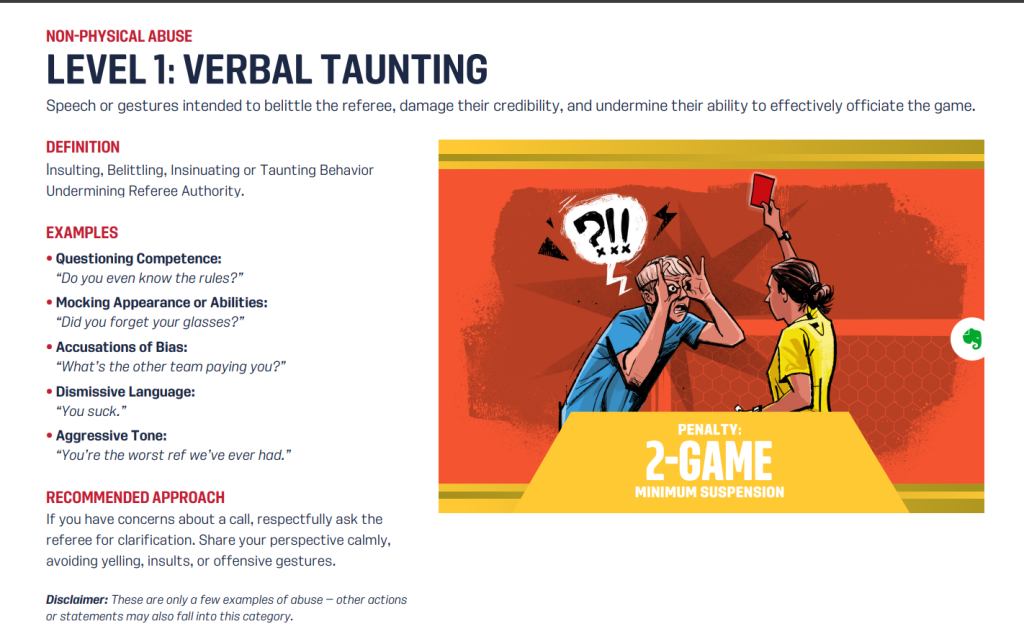
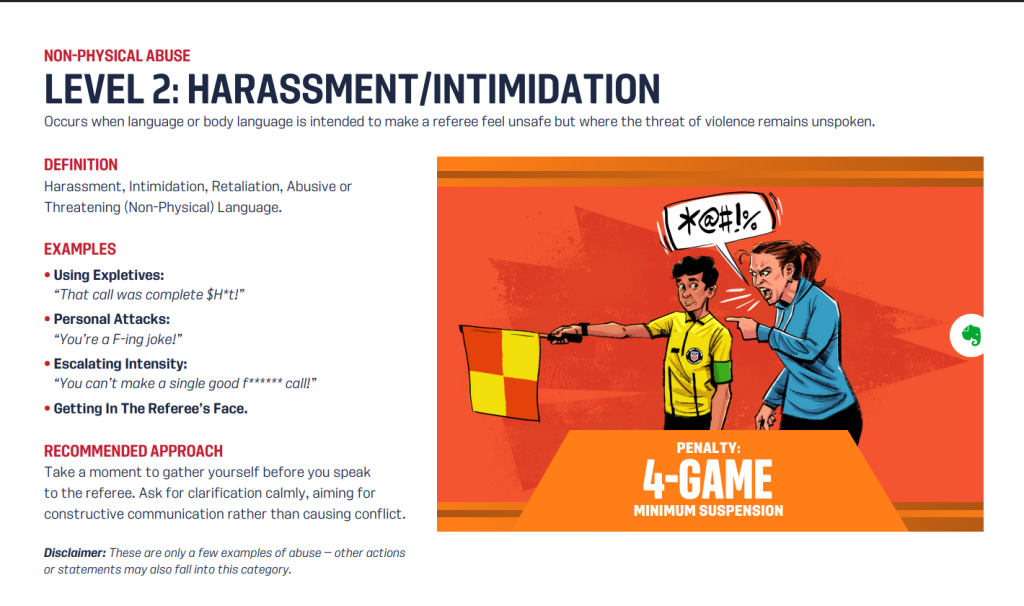
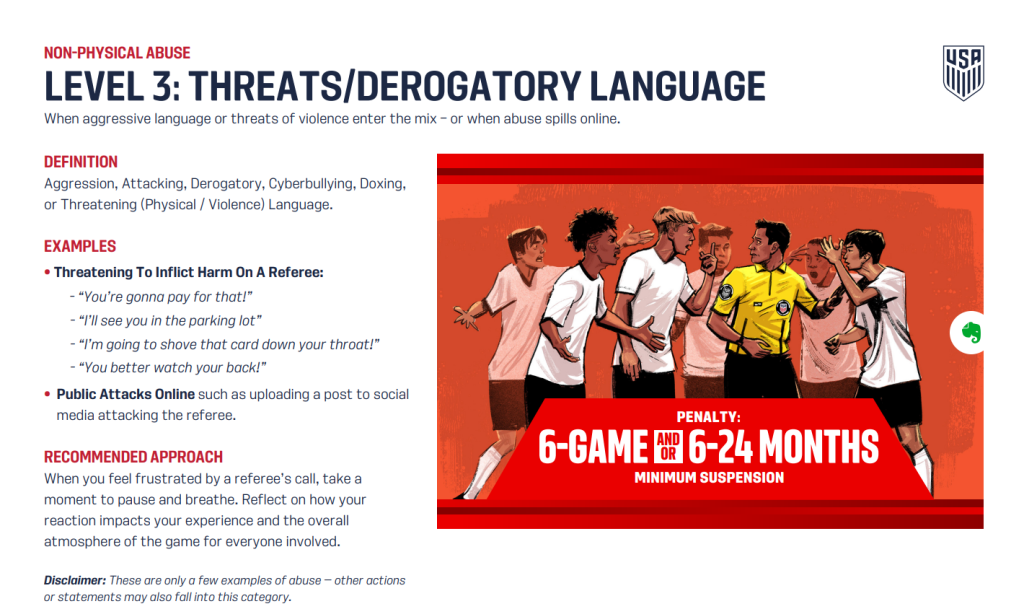
Remember, if we do nothing, then the participants will assume it is allowed. If they are allowed to do it game after game, then it will get worse. WE have the POWER and DUTY to stop the behavior and report it. If we ignore it or become desensitized to it, then we contribute to the problem. Let’s do our part to make our game enjoyable for everyone – players, coaches, spectators and referees!